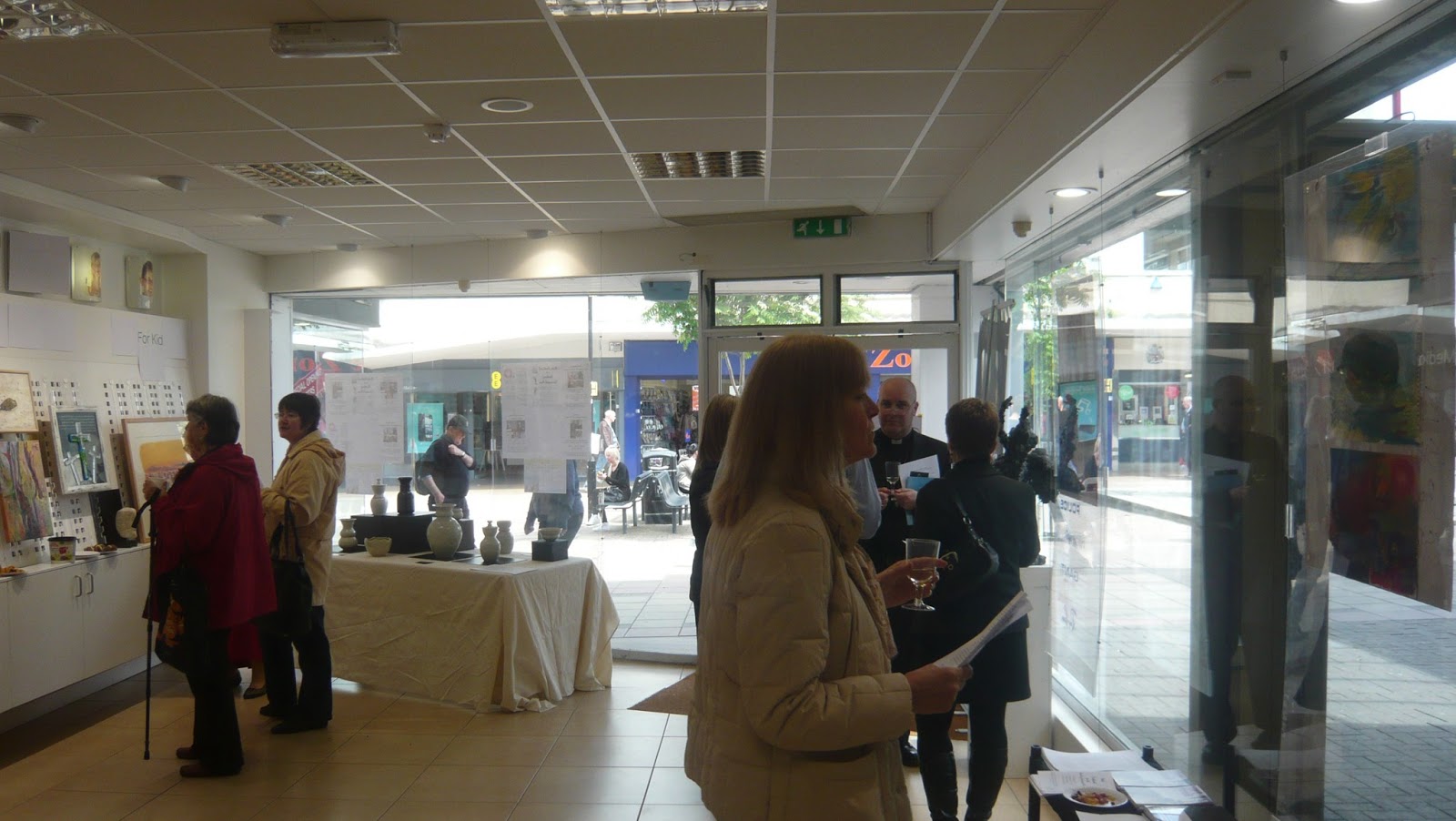
The programme of art talks throughout the day at the
'Run with the Fire' exhibition today provided a broad exploration of approaches to the expression of spirituality in and through the visual arts, while
Harvey Bradley provided a practical expression of the same with the painting demonstration.
Mark Lewis quoted
Rudolf Steiner, who said that "art is the daughter of the divine," as he began his exploration of 'The Spiritual Image in Art'. He defined spiritual as the "depth dimension in life" as he outlined the way in which the development of abstract art built on the sense of mystery being probed outside of traditional representational Christian iconography by nineteenth century Romantics such as
Caspar David Friedrich and
J.M.W. Turner. Early abstractionists such as
Mondrian,
Kandinsky and
Malevich had a sense that the spiritual world was governed by laws which mirrored natural laws and which could be expressed in visual form. Their works imply that there is a hidden logic in nature; a religious symmetry underpinning the material universe. As Plato stated, "God geometrizes." Similarly
Barnett Newman and
Mark Rothko were attempting to dig into metaphysical secrets by means of non objective art which equated to the 'Via Negativa'. He ended by highlighting the colour field paintings of
Michael Finn with their sense of the sublime, density of experience and wonder of light.
Steve Scott quoted
Rowan Williams as saying that the one thing he longed for was a "Christianity in this country able again to capture the imagination of our culture." Scott went on to outline the genesis of the
'Run with the Fire' project which provided the basis for this exhibition and which he hoped, in line with the butterfly effect, might be a small action leading to big effects. He explained how involvement in an arts conference held in Bali had kickstarted the idea of a DVD for the Olympics, initially intended for the Beijing Games and on
the theme of guns into ploughshares. When this proved unfeasible for Beijing, other contacts led to Veritasse and commission4mission and the idea of a juried project on the Olympic/Pentecost imagery of fire. The 'Run with the Fire' project attracted 25 international artists and the
DVD produced contained both a digital exhibition and a guide to setting up arts events. The DVD was slowly but surely generating new arts projects/exhibitions in various parts of the UK and abroad. The aim was to stay connected as the butterfly effect came into play.
In '
Stanley Spencer: A Visionary for our Time', Mark Lewis described Spencer as a unique non-conformist whose work does not conform to any movement but is a glorious celebration of the sacred in the everyday. Lewis used specific paintings by Spencer to outline his main themes and the development of his work. The two great influences on his work were the Bible and Cookham. He explored with sensual wonder a personal vision of Christianity in which redemption, resurrection and heaven are all now as everyone is embraced and elevated by a love which brings humanity back to God. His experiences during the First World War as a medical orderly brought him into contact with broken, shattered humanity and his work subsequently tried to recover a paradise lost.
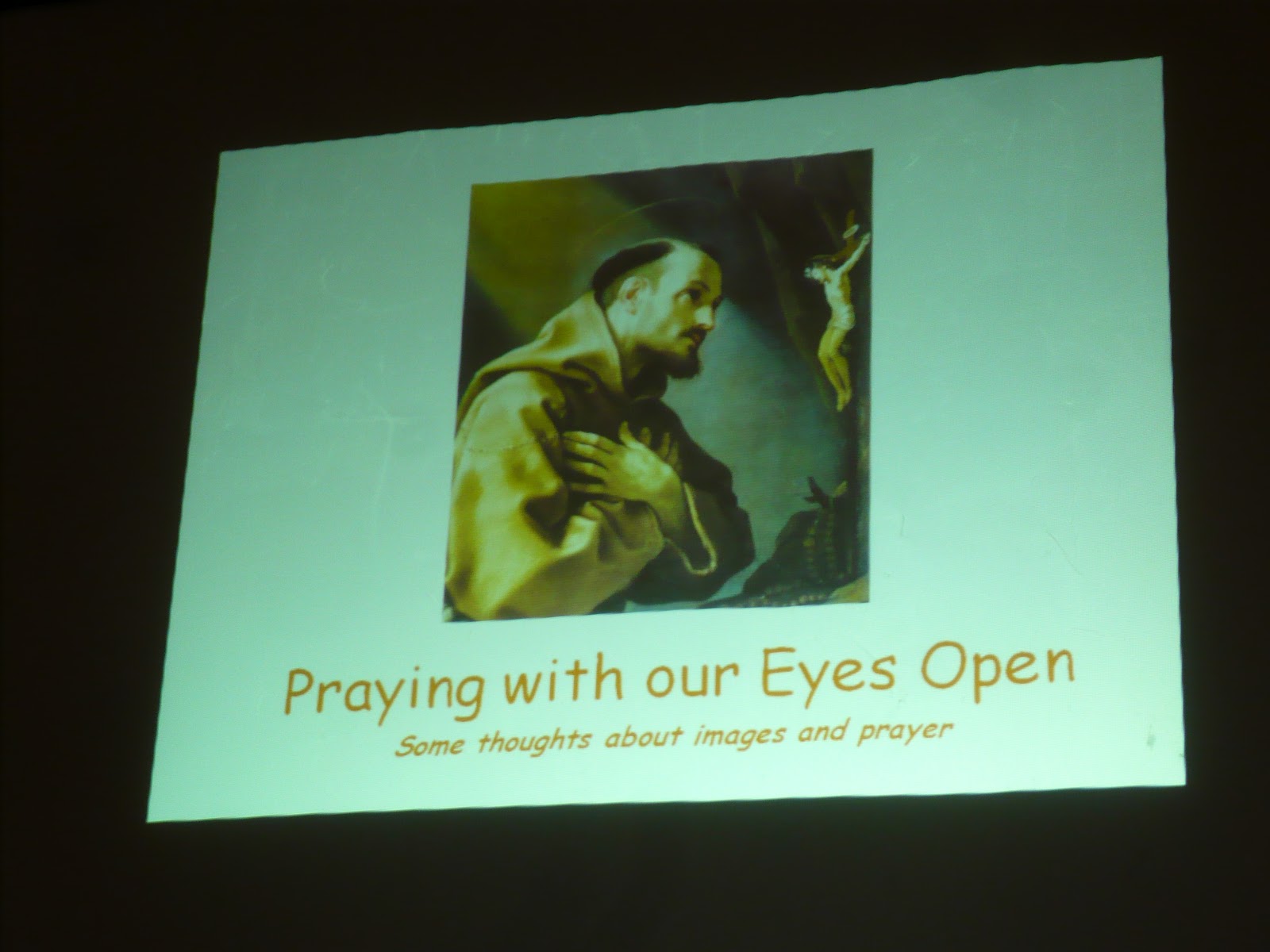
In 'Praying with our eyes open'
Glenn Lowcock began with the yearning of the Psalmist to see the face of the hidden God. God's invisibility could be associated with displeasure and doubt but also with renewal (Elijah on Mount Carmel) and searching (the Shekinah story of the presence of God being like scattered sparks buried deep in the world).
John Berger wrote in
Ways of Seeing that visibility is simply to do with seeing but also of being seen. God's seeing of us is part of his active creating. The hidden God became visible in Christ meaning that sight and images become a new way of approaching God. In the Eastern Church this leads to Church Art becoming one of the five sources of Church Tradition.
Pavel Florensky writes of icons as a window through which the divine is seen in prayer. The conversion of
St Francis began with scripture and was confirmed through sight of a crucifix in the Church of St Damiano. Christ's eyes are open on the crucifix which captivated Francis. He is looking into our world, our space. In response, St Francis and
St Clare open their eyes wide to gaze on God and on his world. St Clare encourages us to study our face in him.
In 'Emotional Tourist', Steve Scott described his journey from modernism, through post-modernity to a meta-modernity that combines ideas and media, working across mediums through relational processes. The visual depiction of Trinitarian relationality contained in
Rublev's icon of the Trinity served as his thesis statement. His 1989 trip to Bali (where shadow play stories from John's Gospel had informed the Eucharist) and his 2011 trip to Isenheim (where
Grunewald's altarpiece depicts Christ as co-sufferer with those celebrating ther Eucharist) were the personal bookends to this journey. Within this he had also drawn on relational aesthetics and social applications of open systems processes. His
'Crossing the Boundaries' open systems project with
Gaylen Stewart was one result from this thinking and
Lilias Trotter had become a role model for his thinking on process, relationship and dialogue. He shared spoken word performances and images on these themes to a backing of sound loops.
Finally,
Jonathan Evens pointed to the pervasiveness of religious and spiritual themes in twentieth century and contemporary Western art by giving a whistlestop and inevitably partial tour of these religious themes and some of those artists that have used them. He began with the catalytic encounter of Émile Bernard and Paul Gauguin in Brittany in 1888 which resulted in Post Impressionist paintings exploring the Catholic soul of Breton peasants. Bernard and Gauguin shared their new style with Paul Sérusier who, together with fellow art students including Maurice Denis, formed the Nabis. Denis became one of the most significant artists in the French Catholic Revival, being prominent in the Nabis, as a Symbolist, and, through his Studios of Sacred Art, contributing to a revival of French Sacred Art. Denis’ influence was felt among Symbolists and Sacred Artists in Belgium, Italy, Russia and Switzerland, in particular.
A second circle of influence within the French Catholic Revival gathered around the philosopher Jacques Maritain. His book Art and Scholasticism was influential and he organised study circles for artists and others including the Expressionist Georges Rouault, the Surrealist Jean Cocteau, the Futurist Gino Severini, the Dadaist Otto van Rees and abstract art promoter Michel Seupher. His writings were also significant for the community of artists which formed around the sculptor Eric Gill at Ditchling, which included the artist and poet David Jones. Jones further developed Maritain’s ideas of images as signs in his paintings, poetry and critical writings. A third circle of influence gathered around cubist pioneer Albert Gleizes, including Mainie Jellett and Evie Hone (who played significant roles in the development of Modern Art in Ireland) and Australian potter Anne Dangar. Like Eric Gill at Ditchling, Gleizes formed a Catholic arts colony to further his ideas which embraced both painting and society seeking to identify natural rhythms for both.
A final circle of influence developed around the Dominican Friars, Marie-Alan Couturier and Pie Régamey, who insisted that the Roman Catholic Church call for the great artists and architects of their day to design and decorate its churches. The involvement of artists such as Marc Chagall, Férnand Leger, Le Corbusier, and Henri Matisse in
churches such as Assy, Ronchamp and Vence was proof of the
effectiveness of their approach and ministry. A similar approach was taken in
the UK by George
Bell and Walter
Hussey which saw artists such as Henry Moore, Graham
Sutherland, John
Piper, Hans
Feibusch and Cecil
Collins decorating churches.
Expressionist artists such as Emil Nolde, Christian Rohlfs and Albert
Servaes painted biblical scenes with an emotional intensity that was often
more than the institutional churches at the time could accept. Georges Rouault
added to this expressionist intensity with a compassionate Christian critique of
contemporary society. Italian Divisionism and Futurism also included a strong
strand of sacred art through artists such as Gaetano
Previati, Gerardo
Dottori, and Fillia.
Wassily Kandinsky created
abstract art by abstracting from apocalyptic biblical images and felt that
abstraction was the best means available to artists for depicting an unseen
realm. Kasimir Malevich was not
only influenced by the tradition of Russian icon painting but also by the
underlying principle of icons – the presence of an Absolute in the world – to
develop the Suprematist aim of self-transcendence.
Daniel Siedell writes that “for these
and many other avant-garde painters well into the twentieth century, including
Russian immigrants John Graham
and Mark Rothko, modern painting
functioned like an icon, creating a deeply spiritual, contemplative relationship
between the object and viewer.” The influence also went the other way too, as
Abstract Expressionist William Congdon
converted to Roman Catholicism and used this style to create deeply expressive
crucifixions.
Iconographer, Aidan Hart, notes that a revival of
traditional iconography occurred in the twentieth century; led in Greece by Photius
Kontoglou, in Russia by Maria
Sakalova and Archimandrite
Zenon, and in Europe by Leonid
Ouspensky and Fr.
Gregory Kroug. More surprisingly, a Lutheran tradition of iconography has
also developed in Scandanavia led by Erland
Forsberg.
Evangelicalism found artistic expression through the folk
art of the American South with artists such as Howard Finster and Sister Gertrude Morgan gaining
significant reputations. Such artists have often been both naive and visionary
in their style, an approach that also characterised the work of New Zealand
artist Colin MacCahon and
British artist, Albert
Herbert. Other significant visionary artists using Christian themes
and imagery have included Stanley
Spencer, F.N. Souza, Betty
Swanwick, Norman Adams, Roger Wagner and Mark Cazalet.
In
response to the growth of Christian Art on the Asian continent, the Asian Christian Art Association was
founded in 1978 to encourage the visual arts in Asian churches. Australia
encouraged contemporary religious art through the establishment of the Blake Prize in1951. From that date
until the present, its judges have chosen as prize winners artists and works
which reflect the movement in Modern Art from the figurative to the abstract. Wojciech
Wlodarczyk notes that one special aspect of Polish Art in the 1980s was its
links with the Roman Catholic Church. Martial law forced the entire artistic
community to boycott official exhibition spaces and instead places of worship
hosted exhibitions. This period was marked by a profound interest in the whole
question of the sacrum
in art and was characterised by the work of Jerzy
Nowosielski with its thoughts on the nature of religious
art.
There has been extensive use of
Christian imagery by BritArt artists such as Damien
Hirst, Chris
Ofili, Mark
Wallinger, and Sam
Taylor-Wood. In their work, Christian iconography and narrative is often
used as a frame for the artist’s critique of contemporary life including
politics and culture. Finally, on this whistle-stop tour, the work of Lynn Aldrich, Betty Spackman, Peter Howson and Makoto Fujimura provide examples of artists expressing aspects of their Christian faith through work accepted and understood within the mainstream world of contemporary art.
As issues of religion have been largely overlooked in the social and cultural history of twentieth-century art, we need, as curator and author Daniel Siedell has argued, "an alternative history and theory of the development of modern art, revealing that Christianity has always been present with modern art, nourishing as well as haunting it, and that modern art cannot be understood without understanding its religious and spiritual components and aspirations."